
A 6-day Tanzania safari is enough time to see some of the best parts of the northern safari circuit without rushing every single day. You won’t see everything, and you shouldn’t try to. But with the right route, you can fit in Tarangire, the Serengeti, Ngorongoro Crater, and either Lake Manyara or a slower final day back to Arusha.
The best 6-day Tanzania safari itinerary for most first-time visitors is:
| Day | Route | Main focus |
|---|---|---|
| Day 1 | Arusha to Tarangire | Elephants, baobabs and your first game drive |
| Day 2 | Tarangire/Karatu to Serengeti | Long drive, Ngorongoro highlands, afternoon Serengeti drive |
| Day 3 | Serengeti National Park | Full day in the Serengeti |
| Day 4 | Serengeti to Ngorongoro/Karatu | Morning game drive, then travel towards the crater |
| Day 5 | Ngorongoro Crater | Crater game drive, then overnight near Karatu or Lake Manyara |
| Day 6 | Lake Manyara or return to Arusha | Easy final game drive or a simpler travel day |
This route works because it keeps the main highlights in a logical loop from Arusha. It gives you two nights connected to the Serengeti, one full day there, and enough time for Ngorongoro Crater without pretending Tanzania is smaller than it is.
That said, there are a few important trade-offs. Six days is not ideal if you want a slow luxury safari, a serious Great Migration route, or several nights deep in the Serengeti. It’s best for travellers who want a strong first safari, have limited time, and don’t want to spend the whole trip changing lodges.
Is 6 days enough for a Tanzania safari?
Yes, 6 days is enough for a good Tanzania safari if you focus on the northern circuit and don’t overload the itinerary. It’s not enough for every famous park, and it’s not enough to combine safari with Zanzibar unless you’re adding extra days afterwards.
For most people, 6 days works best when it includes:
- Tarangire National Park
- Serengeti National Park
- Ngorongoro Crater
- Lake Manyara as an optional final stop
- Arusha or Kilimanjaro International Airport as the start and end point
The biggest mistake is booking a “6 day safari” where day 1 is just airport pickup and day 6 is only airport drop-off. That can leave you with closer to four real safari days. When comparing quotes, check how many actual game drives are included, where you sleep each night, and how long you’ll spend driving between parks.
The best 6-day Tanzania safari route
The most practical route is a northern circuit loop:
Arusha → Tarangire → Serengeti → Ngorongoro Crater → Lake Manyara or Arusha
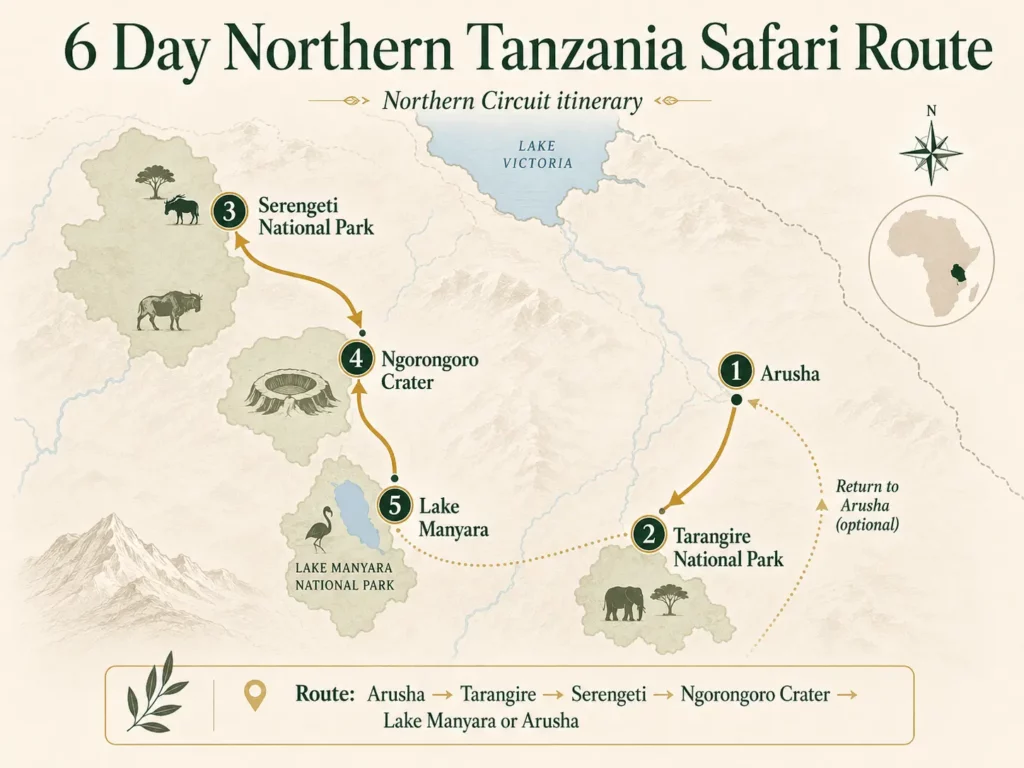
This is the route most travellers should look at first. It keeps the journey simple, includes Tanzania’s most famous wildlife areas, and avoids wasting too much time on awkward transfers.
There are variations, but this is the route that gives the best balance for a first trip. If a tour tries to add too many extra places, it usually means less time where you actually want to be.
Day 1: Arusha to Tarangire National Park
Most Tanzania safaris start in Arusha, which is the main base for the northern circuit. If you arrive the night before, you can leave after breakfast and drive to Tarangire National Park for your first game drive.
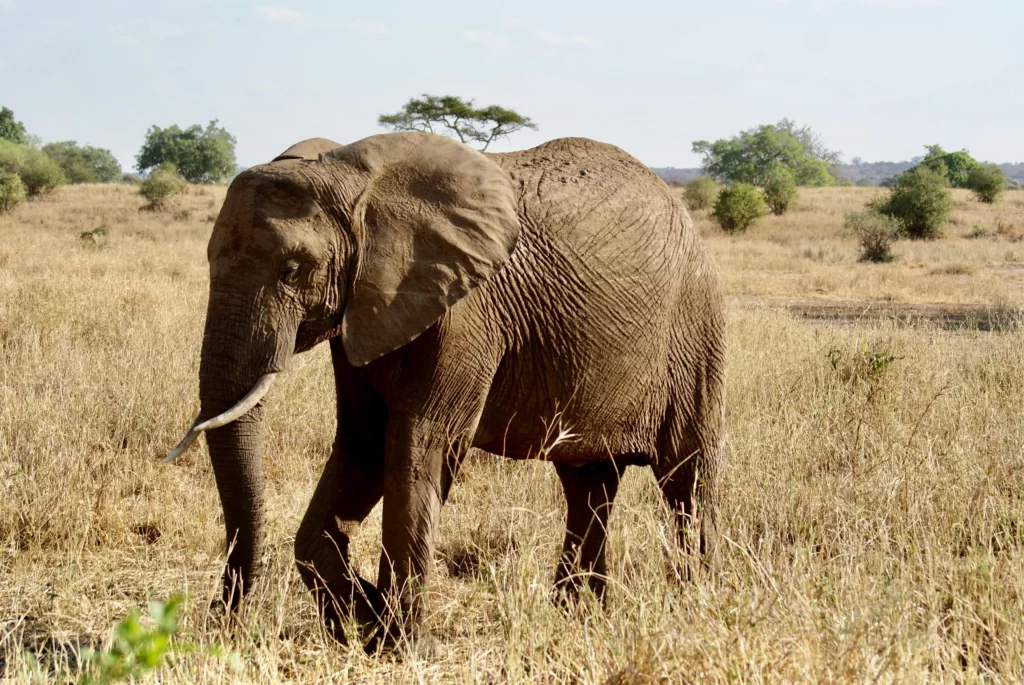
Tarangire is a good place to start because it feels different from the Serengeti and Ngorongoro. It’s known for elephants, baobab trees, dry-season wildlife around the Tarangire River, and a quieter feel than the bigger-name parks.
This first day shouldn’t be too complicated. You’ll drive from Arusha, enter the park, have a game drive, stop for lunch, then continue exploring in the afternoon. Depending on your lodge, you may sleep inside the park, near the park, or closer to Karatu so you’re better positioned for the drive towards the Serengeti the next day.
What makes sense today: arrive in Arusha the day before if you can. Trying to land, clear the airport, drive to Tarangire and have a relaxed game drive on the same day can work on paper, but it’s not the best start after a long flight.
Day 2: Tarangire or Karatu to Serengeti National Park
Day 2 is one of the longer travel days. You’ll usually drive through the Ngorongoro Conservation Area on the way to the Serengeti, with changing landscapes as you move from the highlands towards the open plains.
This is the kind of day where it helps to know what you’re signing up for. You won’t be sitting in the vehicle doing nothing, but it’s still a proper travel day. Depending on your route and stops, you may only arrive in the Serengeti in time for an afternoon game drive.
For most 6-day itineraries, Central Serengeti is the most practical area to stay. It gives you a strong general safari experience without needing extra internal flights or long detours. If you’re travelling during migration season and want to focus on a specific area like Northern Serengeti or Ndutu, the route may need changing.
What makes sense today: don’t judge this day by the number of parks listed. Judge it by where you’ll sleep and how much time you’ll actually get in the Serengeti.
Day 3: Full day in the Serengeti
This is the day you’ll be glad you didn’t rush the route too much. A full day in the Serengeti gives you time to slow down, follow sightings properly, and avoid treating the park like a quick stop.
The Serengeti is huge, and one day won’t cover it all. But a full day based in the right area can still be excellent. You’ll usually do either a full-day game drive with a packed lunch or a morning and afternoon drive with a break at camp in between.
Central Serengeti is a sensible base for many first-time safaris because it works across much of the year. It’s also easier to combine with Ngorongoro than more remote parts of the park.
What makes sense today: keep this as a proper Serengeti day. Avoid itineraries that give you only a quick afternoon in the park before moving on again.
Day 4: Serengeti morning game drive, then travel to Ngorongoro or Karatu
Day 4 usually starts with a final morning game drive in the Serengeti. After that, you’ll begin the drive back towards the Ngorongoro area.
Some itineraries sleep on the crater rim, while others stay in or near Karatu. Staying on the rim can make the next morning easier, but it often costs more. Karatu is usually better value and still works well for a crater day if you leave early.
This is another day where the route matters. You don’t want to spend the whole day in transit and then arrive too late to enjoy where you’re staying. A good guide or operator should be clear about the timings.
What makes sense today: use the morning well, then accept that the afternoon is partly about getting into position for Ngorongoro Crater.
Day 5: Ngorongoro Crater game drive
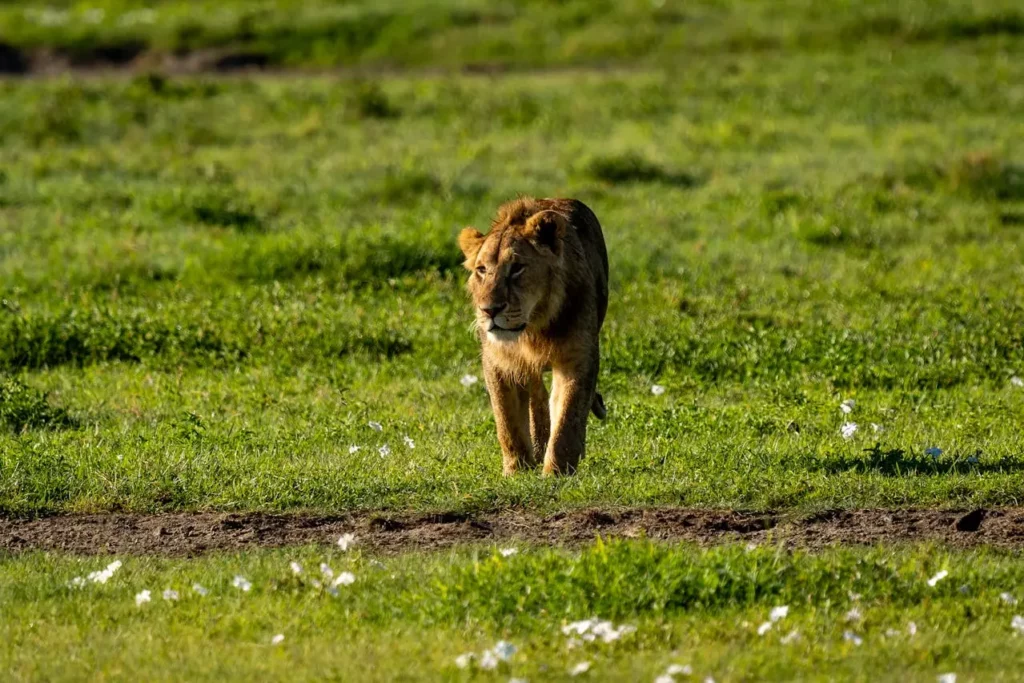
Ngorongoro Crater is one of the easiest places in Tanzania to see a lot of wildlife in a relatively compact area. It’s not a hidden spot, and it can feel busy, but it’s still worth including on a first Tanzania safari.
Most crater days start early. You’ll descend into the crater for a game drive, have a picnic lunch, then continue exploring before driving back out later in the day.
The crater is especially useful on a 6 day itinerary because it gives you a strong wildlife day without needing another long journey deeper into the Serengeti. It also feels different from Tarangire and the Serengeti, which helps the whole safari feel more varied.
What makes sense today: leave early, keep expectations realistic about other vehicles, and don’t skip it just because it’s popular. Some places are popular because they work.
Day 6: Lake Manyara or return to Arusha
You have two good options for the final day.
The first is to visit Lake Manyara National Park before returning to Arusha. This works best if your flight is late, you’re staying in Arusha that night, or you want one more gentle game drive. Lake Manyara is known for its groundwater forest, birdlife, primates and views along the Rift Valley escarpment.
The second option is to skip Lake Manyara and travel back to Arusha at a slower pace. This can be the better choice if you’ve had several early starts, your flight timing is awkward, or you’d rather not squeeze in another park for the sake of it.
Lake Manyara is a nice addition, but it isn’t essential. If the quote becomes too rushed because of it, drop it and protect the quality of the Serengeti and Ngorongoro days.
What makes sense today: don’t let the final day ruin the pacing. If you have time, Lake Manyara works. If you don’t, a clean return to Arusha is fine.
Best time for a 6-day Tanzania safari
You can do this itinerary year-round, but the experience changes by season.
June to October is the classic dry-season window. Wildlife is often easier to spot because animals gather closer to water, vegetation is thinner, and roads are usually more reliable. It’s also a popular time, so prices and demand can be higher.
January to March can be very good, especially if you want to adapt the itinerary towards Ndutu and the southern Serengeti area for the calving season. This is one of the better times to think about a migration-focused version of the route.
April and May are the long-rain months. Safaris can still happen, and prices may be better, but some routes can be muddy and certain camps may close. It can suit travellers who want fewer crowds and don’t mind weather uncertainty.
November and December bring the short rains. This can still be a good time to visit, with greener landscapes and fewer people than peak season, but rain can affect road conditions and sightings.
How much does a 6-day Tanzania safari cost?
Prices vary a lot depending on your travel style, group size, accommodation and whether you drive or fly between parks. As a rough planning guide:
| Safari style | Rough cost per person | What to expect |
| Budget camping | $1,500–$2,400 | Basic camping, shared facilities, simple meals |
| Mid-range private safari | $2,600–$4,500 | Private vehicle, comfortable lodges or tented camps |
| Luxury safari | $5,000+ | Higher-end camps, better locations, more polished service |
| Fly-in or premium route | Varies widely | Internal flights, remote camps, less driving |
The biggest cost drivers are usually park fees, accommodation, private vehicle costs, fuel, guide costs and crater fees. A private safari for two people will cost more per person than a group safari because you’re sharing the fixed vehicle and guide costs between fewer travellers.
Cheaper isn’t always bad, but if a quote is much lower than the others, check what’s missing. It may use camps far outside the parks, reduce real game-drive time, use a shared vehicle when you expected private, or count transfer days as safari days.
Where should you stay on this route?
For a 6-day safari, location matters more than fancy extras. A beautiful lodge isn’t much help if it adds hours of driving at the wrong point in the route.
A sensible accommodation pattern is:
- Night 1: Tarangire, near Tarangire, or Karatu
- Nights 2–3: Central Serengeti
- Night 4: Ngorongoro rim or Karatu
- Night 5: Karatu, Lake Manyara area, or Arusha, depending on your final day
If the budget allows, staying inside or close to the Serengeti is worth prioritising. You’re already spending the time and money to get there, so you don’t want to waste the best hours driving in and out from too far away.
Should you include Lake Manyara?
Lake Manyara is worth including if you want variety and your final day has enough time. It’s a smaller, softer-feeling park compared with the Serengeti and Ngorongoro, and it can be good for birds, monkeys and forest scenery.
But it’s not the park to prioritise if your main goal is big-cat sightings or maximum wildlife density. In a 6-day itinerary, Lake Manyara should be treated as a flexible extra, not the reason the route becomes rushed.
If you need to make a choice, keep more time for the Serengeti over forcing in Lake Manyara.
Should you fly or drive?
Most 6-day Tanzania safari itineraries use a private 4x4 vehicle from Arusha. This is usually the best balance of cost, flexibility and simplicity.
Flying can make sense if you want to reduce long drives or focus on a specific Serengeti region. For example, flying into or out of the Serengeti can save time, but it also increases the cost. It may be worth it for luxury trips, older travellers, families who don’t want long road days, or people trying to focus on the migration in a short window.
For most first-time visitors, driving is fine as long as the itinerary is honest about travel times.
The best version of this itinerary for the Great Migration
A standard 6-day route can include the Serengeti, but it won’t automatically put you in the right place for the Great Migration. The migration moves through different areas during the year, and no one can guarantee exact wildlife movements.
As a rough guide:
- January to March: look at Ndutu and the southern Serengeti area
- April to May: migration can be harder to plan around because of rain and movement patterns
- June to July: western or central/western routes may be relevant depending on the year
- July to October: northern Serengeti is often the focus for river-crossing season
- November to December: herds often move back south, depending on rains
If the migration is your main reason for travelling, don’t book a generic 6-day itinerary without checking which Serengeti area it uses. “Serengeti” is not specific enough.
What to check before booking a 6 day safari
Before you book, ask these questions:
- How many full game-drive days are included?
- Does day 1 include a real park visit or only airport pickup?
- Does day 6 include a game drive or only airport drop-off?
- Where exactly are the Serengeti nights?
- Are you staying inside the park, outside the park, or near the gate?
- Is the vehicle private or shared?
- How many people will be in the vehicle?
- Are park fees and Ngorongoro Crater fees included?
- Are drinks, tips, laundry or airport transfers included?
- What happens if a road, airstrip or park access issue affects the route?
- Is the itinerary adjusted for your travel month?
A good operator should answer these clearly. If they can’t, that’s a warning sign.
Common mistakes with 6 day Tanzania safari itineraries
Trying to include too many places
A 6-day safari should not try to cover every famous name in Tanzania. If you add too many parks, the trip becomes a checklist with too much driving and not enough time watching wildlife.
Not spending enough time in the Serengeti
The Serengeti deserves more than a quick drive-through. For a 6-day route, aim for at least two nights connected to the Serengeti if your budget allows.
Forgetting that distances are slow
Distances on the map don’t tell the full story. Roads can be rough, park speeds are slow, and wildlife sightings can change the pace of a day.
Booking only by price
Safari pricing can be confusing because two quotes may look similar but include very different accommodation, vehicle setup, park access and real time in the parks.
Assuming the migration will be wherever your itinerary goes
The migration doesn’t follow your booking confirmation. If it matters to you, the route needs to match the season.
Who this itinerary is best for
This 6-day Tanzania safari itinerary is best for:
- First-time safari travellers
- Couples, friends or families with limited time
- Travellers who want the northern circuit highlights
- People starting and ending in Arusha
- Anyone who wants a strong safari without making the route too complicated
It’s probably not the best fit if you want a very slow safari, a remote luxury camp experience, a serious photography trip, or a full Tanzania and Zanzibar holiday in the same six days.
Final thoughts
A good 6-day Tanzania safari is about choosing the right compromises. You can’t do everything, but you can still have a brilliant first safari if the route is planned properly.
For most travellers, the strongest version is Tarangire, Serengeti, Ngorongoro Crater and a flexible final day at Lake Manyara or back to Arusha. Keep the Serengeti protected, don’t overload the route, and check that your “6-day” quote gives you six useful days rather than a couple of transfers dressed up as safari time.
If an itinerary is clear, realistic and honest about the driving, it’s usually a better sign than one that tries to make every day sound effortless.